

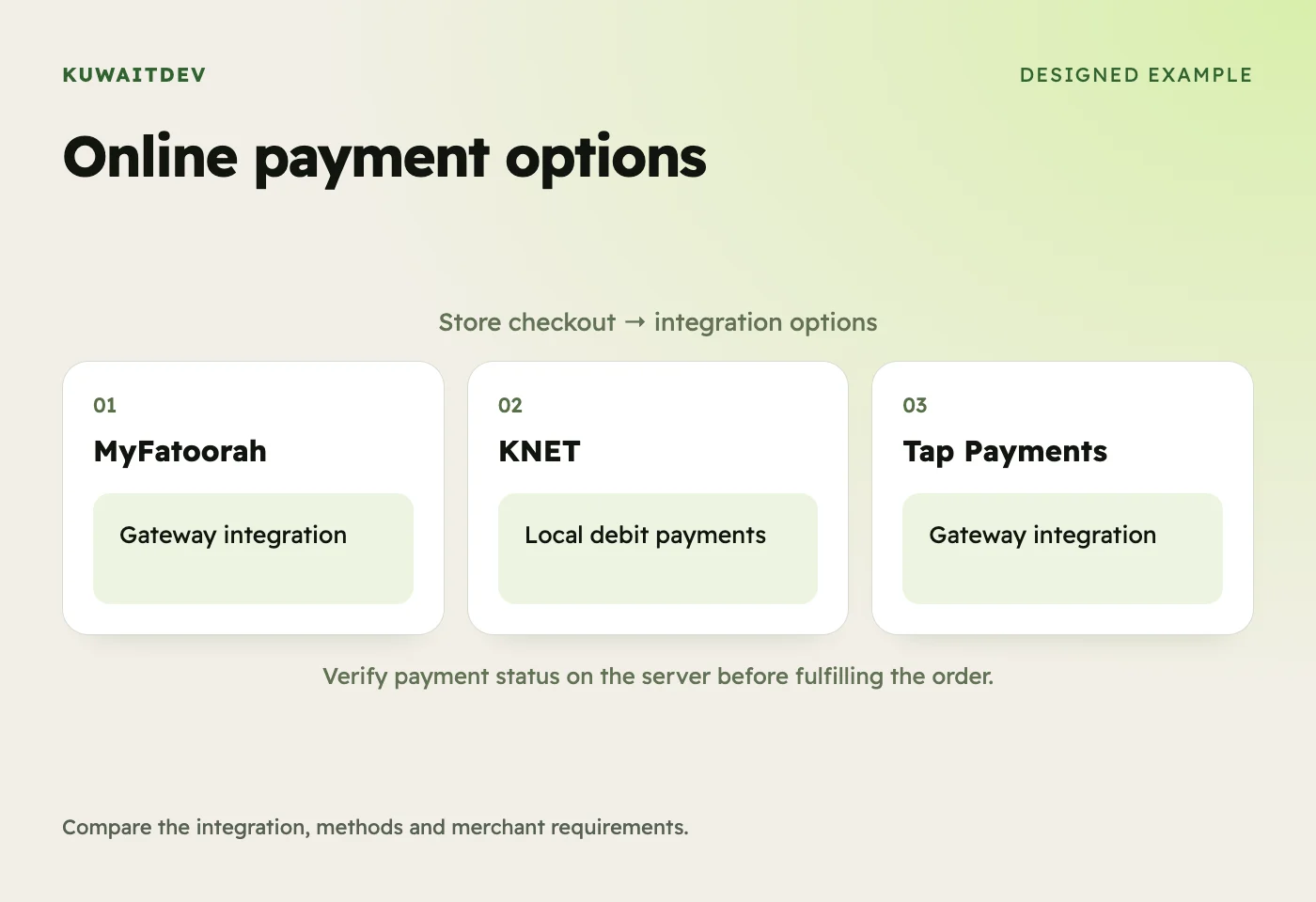
Every Kuwait business taking online payments faces the same question: MyFatoorah, KNET direct, or Tap Payments? We've integrated all three dozens of times. Here's the honest comparison, pricing, supported methods, integration effort, settlement timing, and which one fits your situation.
The 30-second answer
- MyFatoorah, pick this if you want one gateway covering KNET, Visa, Mastercard, Apple Pay, Tabby, Google Pay, plus invoicing tools out of the box. Best for small to mid-size Kuwait merchants. Fastest to launch.
- KNET direct (via KFAST), pick this only if you have high volume and want to skip the gateway markup. Setup is slower, requires bank relationship, and you'll still need a separate gateway for Visa/Mastercard.
- Tap Payments, pick this if you sell across GCC (Kuwait + Saudi + UAE + Bahrain + Oman + Qatar) and want one API for all. Better developer documentation, slightly higher fees than MyFatoorah.
Side-by-side comparison
| Feature | MyFatoorah | KNET direct | Tap Payments |
|---|---|---|---|
| Founded in | Kuwait | Kuwait (KNET network) | Kuwait |
| KNET support | Yes | Native | Yes |
| Visa / Mastercard | Yes | No (need separate acquirer) | Yes |
| Apple Pay | Yes | No | Yes |
| Google Pay | Yes | No | Yes |
| Tabby / Tamara BNPL | Yes | No | Tabby yes, Tamara partial |
| Mada (Saudi) | No | No | Yes |
| Benefit (Bahrain) | No | No | Yes |
| Settlement (T+) | T+1 to T+3 | T+1 | T+2 to T+5 |
| Setup fee | Free | Negotiated with bank | Free |
| Per-transaction fee (KNET) | ~0.250 KWD flat | ~0.100 KWD flat | ~0.250 KWD flat |
| Per-transaction fee (cards) | 2.5% + 0.100 KWD | n/a, separate acquirer | 2.85% + 0.100 KWD |
| Hosted payment page | Yes | Yes (basic) | Yes |
| Embedded checkout | Yes | Limited | Yes (best DX) |
| Recurring billing | Yes | No | Yes |
| Marketplace splits | Limited | No | Yes |
| Webhooks | Yes | Server-to-server only | Yes |
| Refund API | Yes | Yes (manual) | Yes |
| Arabic invoice | Yes (built-in) | n/a | Yes (template) |
| Developer docs quality | Good | Sparse | Best in market |
| KYC time to live | 3–7 business days | 2–6 weeks (bank) | 3–7 business days |
| Typical integration time | 10–27 hours | 20–55 hours | 10–27 hours |
Which payment methods do Kuwait customers actually use?
From our integration data across 40+ Kuwait stores in the last 18 months: KNET still accounts for 55–70% of transactions. Visa/Mastercard sit around 20–30%. Apple Pay is climbing fast, 8–15% on mobile-heavy stores. Tabby and BNPL options are 3–7% but rising. Cash on delivery (where supported) is 5–15% depending on category. If your gateway doesn't support KNET, you lose more than half your revenue. Full stop.
How to pick
Pick MyFatoorah if…
- You're a small-to-mid Kuwait business doing under 50,000 KWD/month online.
- You want one signup that gives you KNET + cards + Apple Pay + Tabby.
- You like the built-in invoice + payment-link tools (great for service businesses).
- You don't sell outside Kuwait much.
Pick Tap Payments if…
- You sell across GCC, not just Kuwait.
- You're a developer-first team, Tap's API is the cleanest in the region.
- You need marketplace split payments (you run a multi-vendor store).
- You want embedded checkout, not a redirect page.
Pick KNET direct if…
- You're a high-volume merchant (5,000+ KNET transactions/month) and the per-tx markup hurts.
- You already have a strong bank relationship willing to onboard you.
- You have engineering capacity to maintain a sparse-docs integration.
- You're willing to add a separate Visa/Mastercard acquirer for non-KNET payments.
Integration effort: what you're actually paying for
Integration time looks similar on paper (10–27 hours for MyFatoorah and Tap, 20–55 for KNET direct). The hidden cost is everything else: testing every payment method end-to-end, handling refunds correctly in your admin, dealing with Apple Pay domain verification, implementing webhooks with signature verification so you don't double-credit orders, and writing the runbook for when payments fail in production. We've shipped dozens of these. At 10 KWD/hour through our MyFatoorah service, KNET service, or Tap Payments service, a typical store goes live in a week.
What about Stripe, PayPal, others?
Stripe doesn't offer KNET. PayPal works but isn't widely used by Kuwait consumers. Both are fine as supplementary methods if you have significant international traffic, but neither replaces a KNET-capable gateway. Most Kuwait stores end up with MyFatoorah or Tap as the primary gateway, plus optionally Stripe for international customers.
Migration between gateways
If you start with MyFatoorah and outgrow it, migrating to Tap (or direct KNET) is straightforward, the checkout UI changes, your refund flow changes, but customer data and order history stay in your store. Plan for a 1–2 week parallel-run period to validate the new gateway before turning off the old one. We've handled several migrations; the trickiest part is matching settlement reports during the transition.
Final recommendation
For 80% of Kuwait businesses: start with MyFatoorah. It's the fastest path to accepting every meaningful payment method. If you grow past Kuwait borders or your transaction volume justifies the engineering investment, migrate to Tap or KNET direct later. Don't over-engineer day 1.
Need help deciding or integrating? Book a free one-hour consultation, we'll review your tech stack and revenue model and recommend the cheapest, fastest path.