

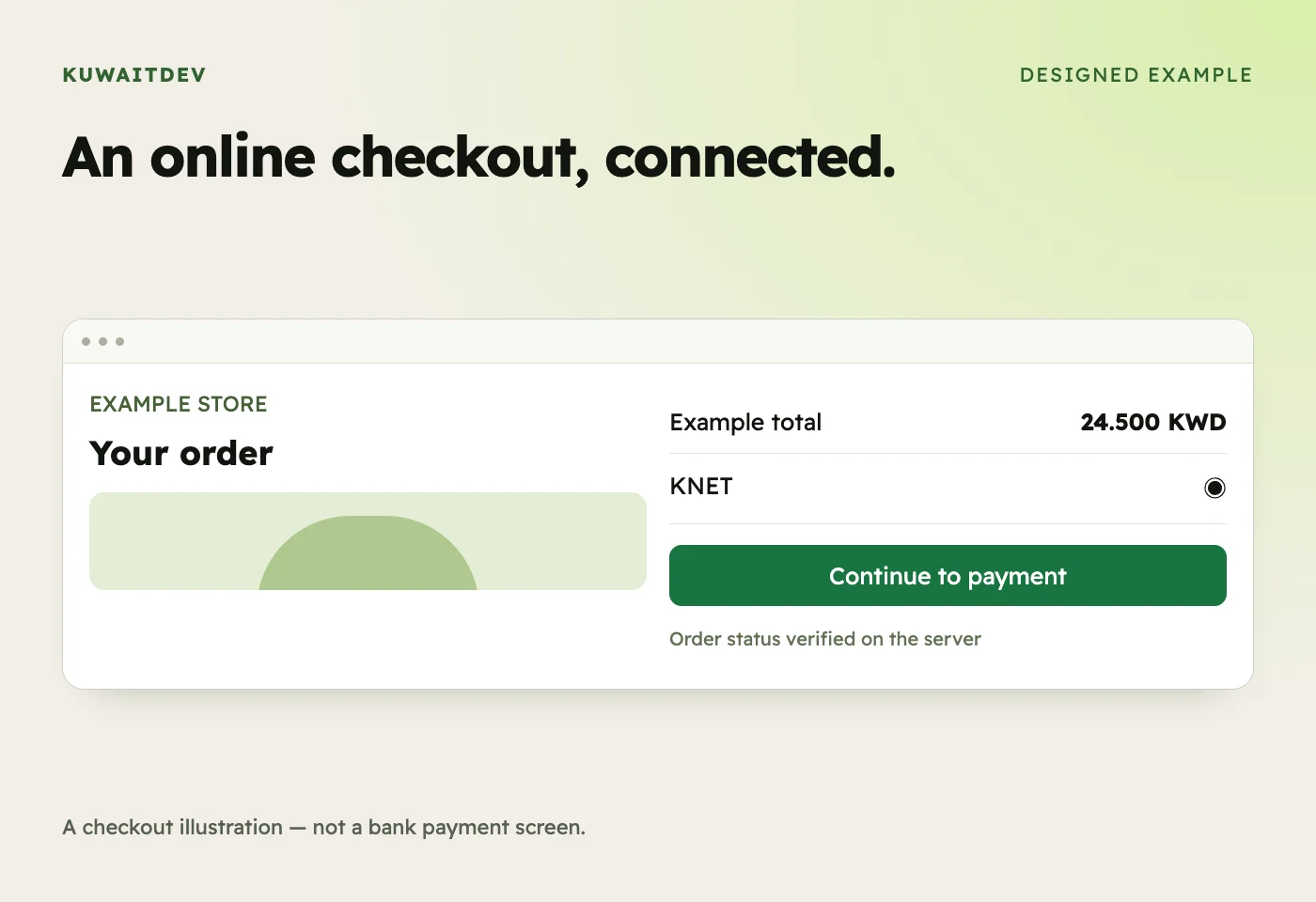
If your Kuwait store does not accept KNET, you are not selling to Kuwaitis. KNET is the national debit network, almost every adult in Kuwait carries a card that runs on it, and the muscle memory at checkout is to look for the KNET logo first. A missing or broken KNET integration is the single most expensive bug a Kuwait merchant can have. We integrate KNET directly with the bank, or through a gateway like MyFatoorah or Tap, at 10 KWD/hour with a typical project landing in 7–17 hours.
What we deliver
- Direct KNET integration via your acquiring bank (NBK, KFH, Boubyan, Gulf Bank, Burgan, CBK), encrypted PaymentId flow, ResponseURL and ErrorURL handling, and the SHA-256 hash signature that proves the response came from the KNET host.
- KFAST test environment setup with the merchant TranportalId, password, and resource key, including the looped test cards so we can prove KNET success, KNET cancel, KNET failure, and 3-D Secure flows before you ever touch production credentials.
- Production credentials process, we prepare the merchant application, business activity proof, IBAN documentation, and the technical compliance form that the bank's KNET team requires; submitted correctly the first time it lands in 2–4 weeks instead of stalling for months.
- Mobile redirect handling for iOS Safari and Android Chrome so the customer is bounced cleanly to the KNET hosted page and back, with the deep-link return preserved for React Native and Flutter apps.
- Refund flow, KNET supports refunds within 180 days through the merchant portal or the API depending on bank; we wire the API path with admin-side audit logging.
- Arabic-language receipts with the encrypted PaymentId rendered for the customer's records, the transaction reference, the KNET-issued auth code, and your CR number.
- Reconciliation export matched against the KNET daily settlement file so finance can close the books without manual matching.
- Webhook + status polling fallback for the cases where the customer closes the browser between authorization and ResponseURL, these are the transactions that look "lost" until you check the bank report.
Why KNET matters for Kuwait businesses
KNET, operated by the Shared Electronic Banking Services Company K.S.C., is the only payment rail that connects every Kuwait bank in a single network. When a Kuwaiti shopper sees KNET at checkout, they trust it the way an American shopper trusts Visa, it is the default. The Central Bank of Kuwait regulates the entire flow, so funds settle in KWD directly into your local bank account, no FX conversion, no international processor markup. For any business selling to Kuwaiti consumers, restaurants, clinics, schools, retail, KNET is not optional; it is the floor.
The technical reality is that KNET is a 1990s-era protocol layered with modern crypto. Each request encrypts the PaymentId with the merchant's resource key, the bank hosts the actual payment page (so PCI scope stays minimal), and the response comes back as a signed redirect that your server must verify. This is harder than wiring Stripe, but it is also why fraud rates on KNET are an order of magnitude lower than card-not-present international flows. If you want to combine KNET with Visa, Mastercard, and Apple Pay under one merchant account, integrating through MyFatoorah or Tap Payments is usually faster than direct-to-bank, and we do both.
Our integration process
- Day 1, Bank selection and merchant application. We confirm your acquiring bank, prepare the KNET merchant application pack (CR, signatory ID, IBAN, business activity proof, technical compliance form), and submit on your behalf.
- Day 2–5, KFAST test integration. While the bank reviews the application, we wire the full KFAST flow: PaymentId encryption, ResponseURL handler, ErrorURL handler, SHA-256 verification, and admin reconciliation view, tested with the official KNET test cards.
- Day 6–8, Bilingual checkout + refund admin. Arabic and English receipts, the encrypted PaymentId display, refund button with role-based permissions, and reconciliation export against the daily settlement file.
- Day 9, Edge cases. Customer closes the browser, double-submit prevention, expired session, 3DS OTP delays, mobile deep-link return, every scenario that creates "ghost transactions" in a bad integration.
- Day 10, Go-live and monitoring. Production TranportalId, password, and resource key are swapped in (encrypted at rest), a real 1 KWD transaction is run end-to-end, and we hook alerts for failed-payment spikes and KNET host outages.
Technical stack and supported features
- Platforms: WordPress / WooCommerce, Shopify (custom app), Magento 2, Salla, Zid, Laravel, Node.js (Express, NestJS), Django, .NET, Flutter, React Native, native iOS / Android.
- KNET parameters we handle: id (TranportalId), password (TranportalPassword), action (1 = sale, 2 = refund), langid (USA / ARA), currencycode (414 for KWD), amt (3-decimal KWD), trackid (your order reference), responseURL, errorURL, udf1–udf5 for custom metadata.
- Encryption: Resource key applied to PaymentId before redirect; SHA-256 hash signature verified on response; PCI scope minimized because the card pan never touches your server.
- 3-D Secure: Native to KNET, every transaction is 3DS by design, and we handle the OTP step including the timeout cases where the customer takes longer than 90 seconds.
- Currency: KWD only; we handle the 3-decimal-place formatting (1.234 KWD, not 1.23) and round-trip the amount correctly against your accounting system.
- Refund window: 180 days from original transaction; we expose this in your admin so finance can refund without portal logins.
Pricing breakdown
| Feature | Hours | Cost (10 KWD/hr) |
|---|---|---|
| Merchant application prep and bank submission | 1 | 10 KWD |
| KFAST test environment integration | 3 | 30 KWD |
| PaymentId encryption + SHA-256 verification | 2 | 20 KWD |
| ResponseURL and ErrorURL handlers | 1 | 10 KWD |
| Bilingual Arabic / English receipts | 2 | 20 KWD |
| Refund flow + admin audit logging | 2 | 20 KWD |
| Mobile deep-link return (iOS + Android) | 2 | 20 KWD |
| Production migration + smoke tests | 1 | 10 KWD |
| Typical project total | 14 | 140 KWD |
KuwaitDev vs typical Kuwait integration shop
| What you need | KuwaitDev | Typical shop |
|---|---|---|
| KNET merchant application correct on first submit | Yes, we prepare every document | Application bounces 2–3 times |
| SHA-256 response hash verified server-side | Always | Often skipped, exposes spoofing risk |
| 3-decimal KWD formatting | Correct everywhere | Off-by-100 errors leak revenue |
| Mobile deep-link return for apps | iOS + Android tested | "Works on web only" |
| Refund inside your admin dashboard | Built-in with audit log | Refunds done from bank portal |
| 10 KWD/hour transparent invoicing | Yes | Fixed quote with hidden scope creep |
Case studies
Hawalli pharmacy chain: direct NBK KNET integration
Problem: The chain's online ordering site routed everything through a generic Stripe-style checkout. KNET customers were dropping off and walking to the physical pharmacy instead, killing the entire purpose of the delivery business.
Our solution: We migrated to direct NBK KNET integration with a custom Laravel admin, added an encrypted PaymentId display on the receipt that customers recognized from in-branch terminals, and built a same-day refund flow tied to the courier return process.
Result: 3.1x increase in online order volume within 60 days, 0 chargebacks in the first quarter, 14-second average checkout time from cart to payment confirmation.
Jabriya private school: fee collection portal
Problem: The school was collecting term fees via bank transfer and PDF receipts, which created a 3-week reconciliation lag every semester and parents would call the office daily asking "did you get my transfer?"
Our solution: We built a parent portal with KNET payment for term fees, bus fees, and extracurricular activities, with each child's account tied to a single KNET PaymentId and instant Arabic / English receipts emailed on success.
Result: 96% of fees collected within 7 days of invoice (vs 65% on bank transfer), 0 reconciliation calls from parents, 2 admin hours saved per day previously spent matching transfers.
Salmiya dental clinic: appointment deposits
Problem: The clinic's no-show rate on cosmetic appointments was 22% because there was no deposit; staff time and chair time were being burned every week.
Our solution: We added a KNET deposit flow to the appointment booking page, 10 KWD non-refundable deposit at booking, deducted from the final invoice if the patient shows. SMS confirmation with the encrypted PaymentId acted as the booking proof.
Result: No-show rate dropped from 22% to 4%, 12 extra appointments per week recovered, 0 disputes on the deposit policy in 6 months.
Need KNET on your Kuwait site or app? Start with our KNET integration guide, review our 10 KWD/hour pricing, or contact us to scope your project. If you also want Visa, Mastercard, Apple Pay, or Tabby in the same flow, see our MyFatoorah and Tap Payments integrations.