

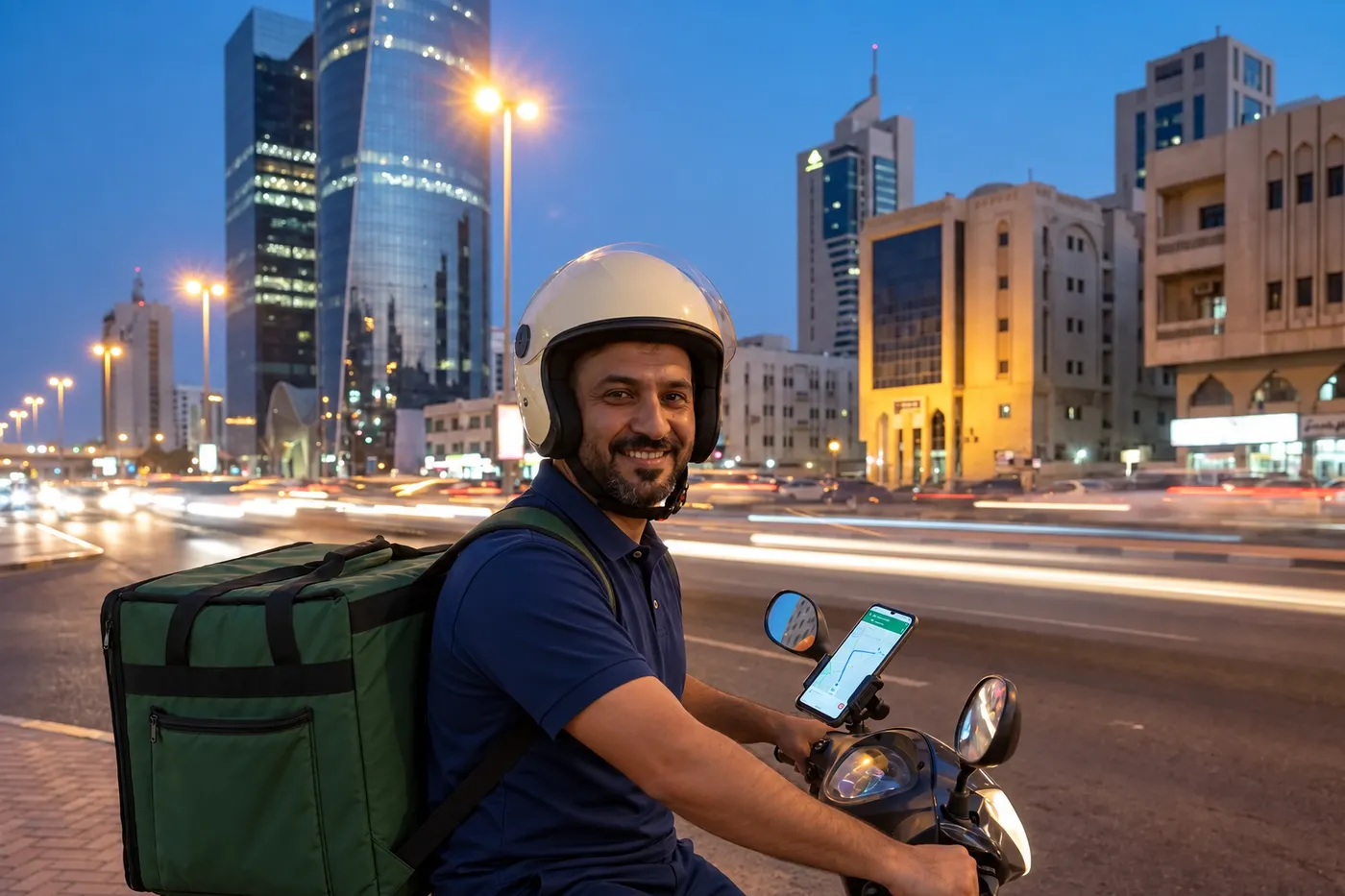
The challenge
A delivery business that lives on aggregators hands over 15 to 30 percent of every order and never learns who its customers are. Building your own customer app, driver app and dispatch screen moves the margin, the data and the customer relationship back to you, and it only makes sense once your order volume is steady enough to carry it.
This page is for businesses that want a delivery app built for them: a restaurant group, a pharmacy chain, a water or gas supplier, a wholesaler, a courier company. If you are looking for an app to order food or parcels as a customer, this is not it. If you deliver goods in Kuwait and you want your own customer app, your own driver app and your own dispatch screen instead of renting someone else’s, keep reading. Projects here run 85 to 265 hours at 10 KWD per hour, so 850 to 2,650 KWD.
Why businesses in Kuwait build their own
Aggregators are a good way to start and an expensive way to stay. Commission of 15 to 30 percent of every order comes out of the thinnest margin in your business, and it is not the only cost. The customer belongs to the platform, not to you. You cannot see who orders twice a week, you cannot message them, and you cannot fix a bad delivery because you did not know it happened.
Owning the platform changes three things: the commission stays with you, the phone numbers and order history are yours, and you decide the delivery promise rather than accepting the one the platform makes on your behalf. The trade is that you now run a delivery operation, including drivers, dispatch and the complaints. That is worth doing at steady volume and not worth doing before it. Read our mobile app development practice for how the build itself is organised.
Three apps, one system
The customer app is where the order is placed. It carries the catalogue, the address book, the payment and the tracking. Most people in Kuwait will order from a phone, at night, on a mobile connection, so it has to be fast and it has to read properly in Arabic.
The driver app is the one that decides whether the operation works. Drivers get the assigned orders in sequence, navigation to the pin, a one-tap call to the customer that hides both real numbers, proof of delivery by photo or signature, and a running total of the cash they are holding. It has to work with one hand, in daylight, in a car.
The dispatch screen is what your supervisor watches. Live orders, which driver has what, who is free, what is late, and the ability to reassign in one drag. Automatic dispatch can come later; every operation we have built starts with a human who can override it.
The details that decide whether it works in Kuwait
Addresses. An address here is a governorate, an area, a block, a street, sometimes a jadda, and a house or building number. A single free-text box guarantees phone calls from lost drivers. We capture the parts separately, save the customer’s usual addresses, and add a map pin because the pin is what the driver actually navigates to.
Cash on delivery. Cash is still a normal way to pay here, and it creates a reconciliation problem rather than a payment problem. The driver app tracks collected cash per order and per shift so the end of day is a figure both sides agree on.
KNET. Prepaid orders are lighter to run and easier to reconcile, and in Kuwait prepaid means KNET first, card second. Charge at the door if you need to, but make paying in advance the easy path.
Zones and promises. Delivery fees, minimum order values and time windows should be set per area by your own team, not hard coded. Ramadan alone will make you change them.
Messages. Push notifications are missed. A WhatsApp message at accepted, out for delivery and arrived cuts the number of “where is my order” calls more than live tracking does. That sits with our automation work.
What a typical project looks like
- A free first hour with an engineer to size the operation: orders per day, drivers, areas, and what you use today.
- We map the order flow end to end, including refunds, cancellations and a driver who cannot find the address.
- Arabic and English screens are designed for all three apps before anything is built.
- The dispatch screen and driver app are built first, because that is where the operational risk sits.
- The customer app, KNET and the message sequence follow.
- A pilot with a few drivers and one area, then publishing to the App Store and Google Play, then the wider rollout.
What it costs
| Scope | Hours | Cost |
|---|---|---|
| Customer app, driver app and dispatch screen, KNET and cash, manual assignment | 85 to 135 | 850 to 1,350 KWD |
| The same plus live tracking, zones and pricing rules, WhatsApp updates, reporting | 145 to 215 | 1,450 to 2,150 KWD |
| Full platform with automatic dispatch, route batching, POS or ERP connection and analytics | 220 to 265 | 2,200 to 2,650 KWD |
Build a figure for your own scope in the cost calculator, compare it against the ranges in our guide to app costs in Kuwait, and see the hourly rate and partnership discounts on the pricing page. Budget separately for running costs: store accounts, maps, messaging and hosting are ongoing, and we will tell you the monthly figure before you commit.