

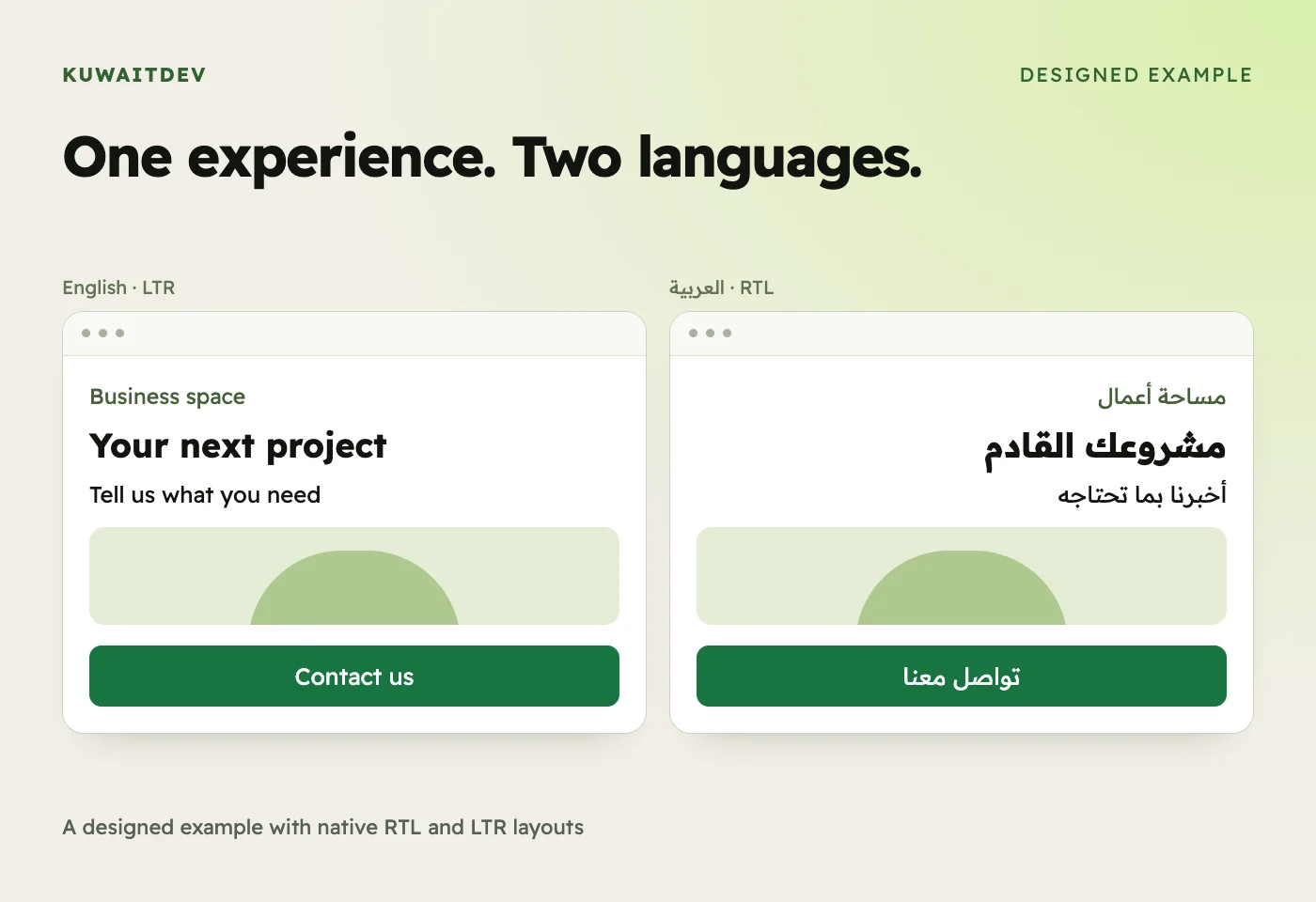
Reach all of Kuwait, in Arabic and in English. Most sites here claim to do that and then fail on the Arabic side: the layout is the English one flipped, the text is machine translated, and the Arabic pages never appear in search. A real bilingual site is two experiences that happen to share a code base, and it adds 20 to 35 percent to the hours of the project it sits inside.
A right to left layout is not a mirrored English layout
Flipping a page is the easy part, and it is where most builds stop. The harder part is knowing what must not flip.
Text, menus, columns, form labels and the reading order flip. Your logo does not. Phone numbers do not, and a Kuwaiti number written right to left is unreadable. Latin brand names stay as they are, which means an Arabic sentence containing “Shopify” needs the two directions handled inside one line. Play buttons, progress bars, volume controls and most charts keep their direction because they follow the timeline or the axis, not the language.
Then there are the details you only catch on a real phone: the back arrow that should point right, the shadow falling on the wrong side of a card, the price that renders as a mathematical expression because a currency symbol sat next to a Latin numeral. We design the Arabic screens as their own screens and check them on a phone before anything is built.
Arabic typography, which decides whether anyone reads it
Arabic on screens fails for reasons English never has. The default system font is almost always the wrong choice: letters join badly at small sizes, and the line height that suits Latin text makes Arabic look cramped. Arabic has no capital letters either, so the tricks English uses for emphasis do not exist and the hierarchy has to come from size and weight.
We pick a typeface made for screens, set the line height for Arabic rather than inheriting the English one, size Arabic text a step larger than its English counterpart because it reads smaller at the same value, and decide up front whether numbers appear as ١٢٣ or 123. On price and quantity screens that single decision changes how fast people scan.
Two languages, two sets of search behaviour
Arabic and English visitors do not search for the same thing in the same words, so one keyword list cannot serve both. Arabic searches lean toward تصميم and برمجة over the formal word for development, they carry شركة and أفضل and الكويت, and questions start with كم تكلفة. The word order is different, definite articles change the phrase, and plurals do not match what a translator would produce.
Each language gets its own address, its own page titles and descriptions, and language tags that tell search engines which version belongs to which reader. Both versions go into the sitemap. The language switch takes a reader from an Arabic page to the same English page, not back to the home page, because sending people to the start is how you lose them. Our guide to building a bilingual site covers the structure decisions in more detail.
How we work
- We decide, page by page, what is translated and what is written natively in Arabic. This list is the project’s real scope.
- We design the Arabic screens alongside the English ones, in the design phase, not after it.
- We build both directions from one set of components, so a change made once appears correctly in both.
- We research Arabic keywords separately and write the Arabic titles, descriptions and headings from that research.
- We set up the editor so every page holds both languages in one screen, and an empty Arabic field is visible before publishing rather than after.
- We test on real phones in both directions, proofread the Arabic with a native reader, and hand your team a short guide to publishing in both languages.
Cost
The Arabic side is priced as a share of the project it belongs to, at 10 KWD per hour. See the pricing page and the cost calculator.
| Base project | Base cost | Arabic side | Added cost |
|---|---|---|---|
| Landing page, 13 hours | 130 KWD | 3 to 5 hours | 30 to 50 KWD |
| Business website, 65 hours | 650 KWD | 13 to 23 hours | 130 to 230 KWD |
| Online store, 135 hours | 1,350 KWD | 27 to 45 hours | 270 to 450 KWD |
Every project we deliver through our web development practice ships bilingual, so on a new build this is already inside the estimate. The percentage matters most when you are adding Arabic to a site that never planned for it.
Pitfalls
Machine translation is the obvious one, and customers spot it in a sentence. The less obvious one is publishing Arabic pages nobody maintains: a current English blog beside an Arabic section last updated two years ago tells a Kuwaiti customer exactly how seriously you take them. Decide who writes the Arabic before you commit to having it.
Watch for content trapped in images. Text baked into a banner cannot be translated, cannot be searched and cannot be read aloud, and it is the most common reason an Arabic page has nothing in it for search engines to index.