

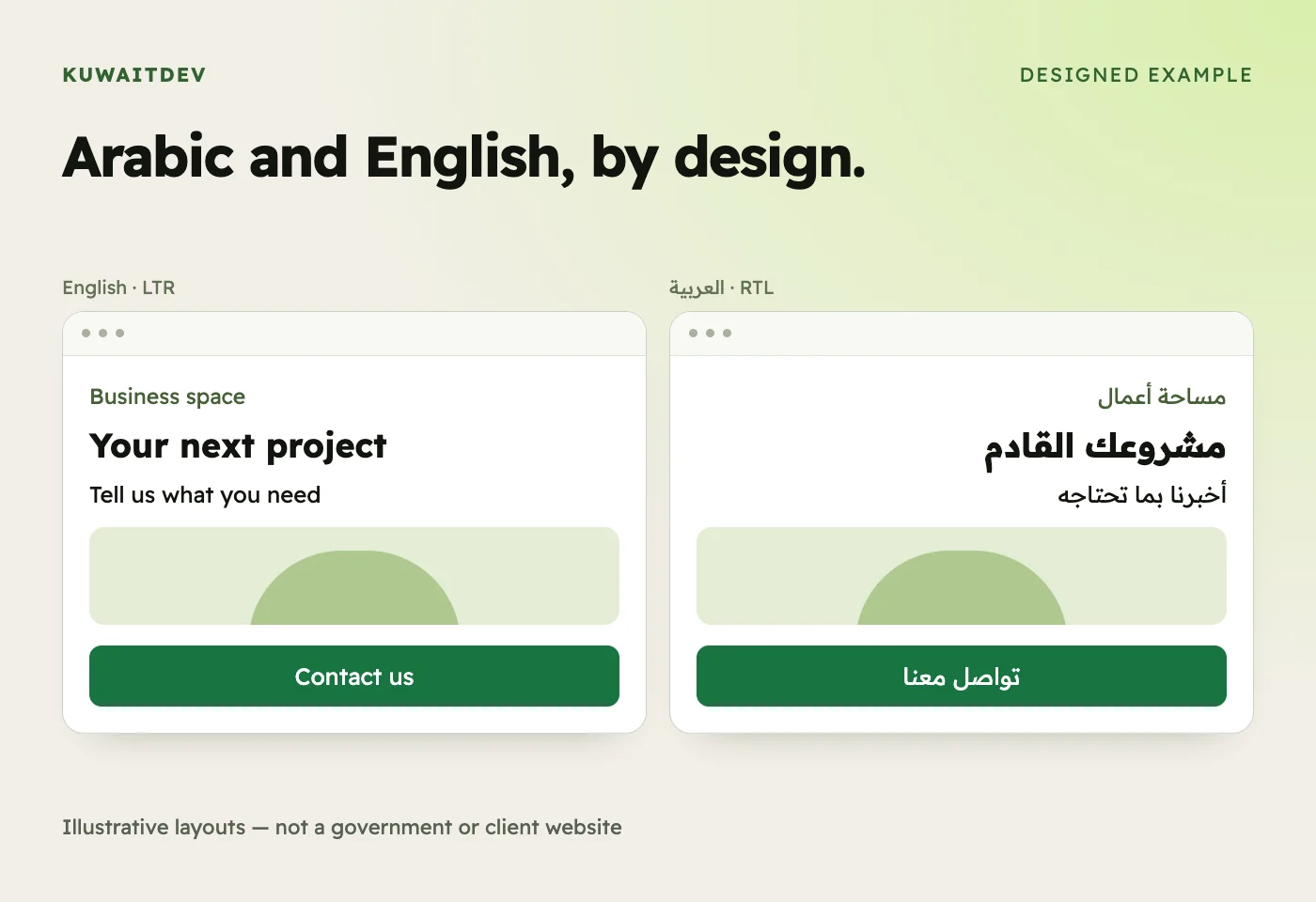
A bilingual Arabic and English website is not a translation job. It is a right-to-left layout that has been designed rather than flipped, a separate search strategy for each language, and a content system your team can keep updated in both. Get those right and the Arabic side performs as well as the English side. Get them wrong and you end up with an Arabic page nobody in Kuwait reads comfortably and nobody finds in search.
True right-to-left design versus a mirrored layout
Mirroring is what happens when a developer takes the English design, reverses the direction, and ships it. The menu jumps to the right, the text aligns right, and everything technically works. It also looks wrong to an Arabic reader, for reasons that are easy to list once you know them. What genuinely has to change:
- Reading order and visual weight. Arabic readers start at the top right, so the element you want seen first belongs there. In a mirrored layout it usually ends up bottom left because nobody re-thought the hierarchy.
- Things that must not flip. Arrows meaning “next” flip. Arrows meaning “download” or “play” do not. Logos do not flip. Phone numbers, prices and dates stay left to right inside a right-to-left sentence.
- Mixed-direction text. “اتصل على 1809090” contains both directions in one line. Handled badly, the number renders in the wrong order or the punctuation lands on the wrong side. This shows up constantly in prices, model numbers and addresses.
- Forms. Labels, field alignment, validation messages and the submit button all move. Phone and email fields usually stay left to right even in the Arabic form.
- Icons and photography. A photo of someone looking off-frame to the left works in English and looks like it is looking away in Arabic. That is a design decision, not a code one.
If your designer has not built for Arabic before, ask to see an Arabic screen from a previous project. Our UI and UX design work treats the Arabic layout as its own design pass rather than an export setting.
Arabic typography and numerals
Arabic is not Latin text in another font. Letters join, change form by position, and sit differently on the line.
| Decision | What goes wrong | What to do |
|---|---|---|
| Font choice | A font with weak Arabic support renders broken joins or falls back to a system font | Pick a family with a real Arabic cut, and check headings, body and bold |
| Font size | Arabic set at the same pixel size as English reads smaller and denser | Increase Arabic body size, commonly by one or two steps |
| Line height | Arabic diacritics and descenders collide with tight leading | Give Arabic more line height than the English version |
| Bold and italic | Arabic has no true italic, and fake bold distorts letterforms | Use a real bold weight, and use colour or size instead of italic |
| Numerals | Mixing ١٢٣ and 123 on the same page looks careless | Choose one style per site and apply it everywhere, including in the CMS |
On numerals, both Arabic-Indic (١٢٣) and Western (123) digits are normal in Kuwait, and dinar prices carry three decimal places (12.500 KWD) either way. What matters is consistency: pick one, write it into the content rules, and tell whoever updates the site.
How Arabic and English search differ in Kuwait
The same business gets found through different phrases in each language, so keyword research has to be done twice.
- Arabic searches are shorter and more direct. People type “تصميم موقع” far more than the literal translation of “web development”. They add “شركة” and “أفضل”, and they ask price questions starting with “كم تكلفة”.
- Spelling varies. Hamza and ta marbuta are often dropped when typing quickly, so the same query arrives in several forms. Good Arabic content covers the variants without looking stuffed.
- English searches in Kuwait are often longer and include the country name, because the searcher is filtering out results from elsewhere.
- Intent differs by language. In several categories the English searcher is comparing suppliers while the Arabic searcher is ready to call. That changes what belongs at the top of each page.
Two technical points to insist on, because they are cheap at build time and expensive later: every page must declare its language and point at its counterpart in the other language, and every Arabic page needs its own title and meta description written in Arabic. A site that skips this ends up with Google showing the English page to Arabic searchers.
URL structure for two languages
For Kuwait businesses, one option is almost always correct.
| Structure | Example | Verdict |
|---|---|---|
| Language folders on one domain | yoursite.com/ and yoursite.com/en/ | Recommended. One domain, one set of search authority, simplest to run |
| Subdomains | ar.yoursite.com and en.yoursite.com | Workable but splits authority and doubles the setup for no gain |
| Separate domains | yoursite.com and yoursite.com.kw | Only when the two languages are genuinely different businesses |
| Query strings | yoursite.com/page?lang=ar | Avoid. Fragile in search and ugly to share |
Two rules matter more than the choice itself. The language must live in the URL, so a customer can send an Arabic page to a friend and it opens in Arabic. And the language switcher must land on the same page in the other language, not dump the visitor on the homepage. That second one is the most common annoyance on Kuwaiti bilingual sites, and fixing it after launch means mapping every URL by hand.
Who writes and maintains each language
This decides whether your site is still bilingual in a year. Most Kuwait sites launch with both languages complete, then the English side gets three new pages and the Arabic side gets none. Decide before you build:
- Which language is written first. Usually the one your buyers use. The second is written from the first, by a person, with permission to change examples and phrasing so it reads naturally.
- Who owns each language. A named person, not a department. If nobody owns Arabic, Arabic stops being updated.
- What happens when only one language is ready. Either publish and mark the other as coming, or hold both. Pick the rule in advance so nobody decides under pressure.
- How the CMS handles it. One system managing both languages side by side, with a visible flag for pages whose translation is out of date. Two separate installations means two of every problem.
- What else is bilingual. Order confirmation emails, invoices, SMS, error messages, the 404 page, WhatsApp replies and PDF brochures. These are forgotten in nearly every project and they are where customers notice the seams.
On WordPress, plan this with someone who has run a bilingual site before, because the plugin you choose decides how painful the next three years are. Our WordPress development service and the bilingual website development service both cover this setup.
The mistakes that cost the most
- Machine-translating the Arabic and publishing it unread.
- Arabic pages that are a thinner version of the English ones, which tells Arabic-speaking customers where they rank.
- A language switcher that goes to the homepage.
- Arabic text baked into images, so it can never be edited or found in search.
- Forms and receipts that arrive in English whatever language the customer used.
- Fonts that look fine in the designer’s file and break on an ordinary Android phone.
- Leaving Arabic until “phase two”. A retrofit runs 30% to 50% of the original build cost because the layout has to be reopened.
What it costs and what to do next
Built together from the start, a second language normally adds 20% to 35% to the hours, at 10 KWD per hour. Added afterwards to an English-only site, expect 30% to 50% of what the original build cost. The website cost guide has the hour ranges by project size, and the website planning guide covers what to settle before you speak to any company.
Before your first meeting, answer three questions: which language your customers actually buy in, who inside your business will write and maintain the Arabic, and whether your existing content is worth translating at all. Bring those answers to the free one hour consultation and the estimate you get back will be a real one. The wider practice is on our web development page.