

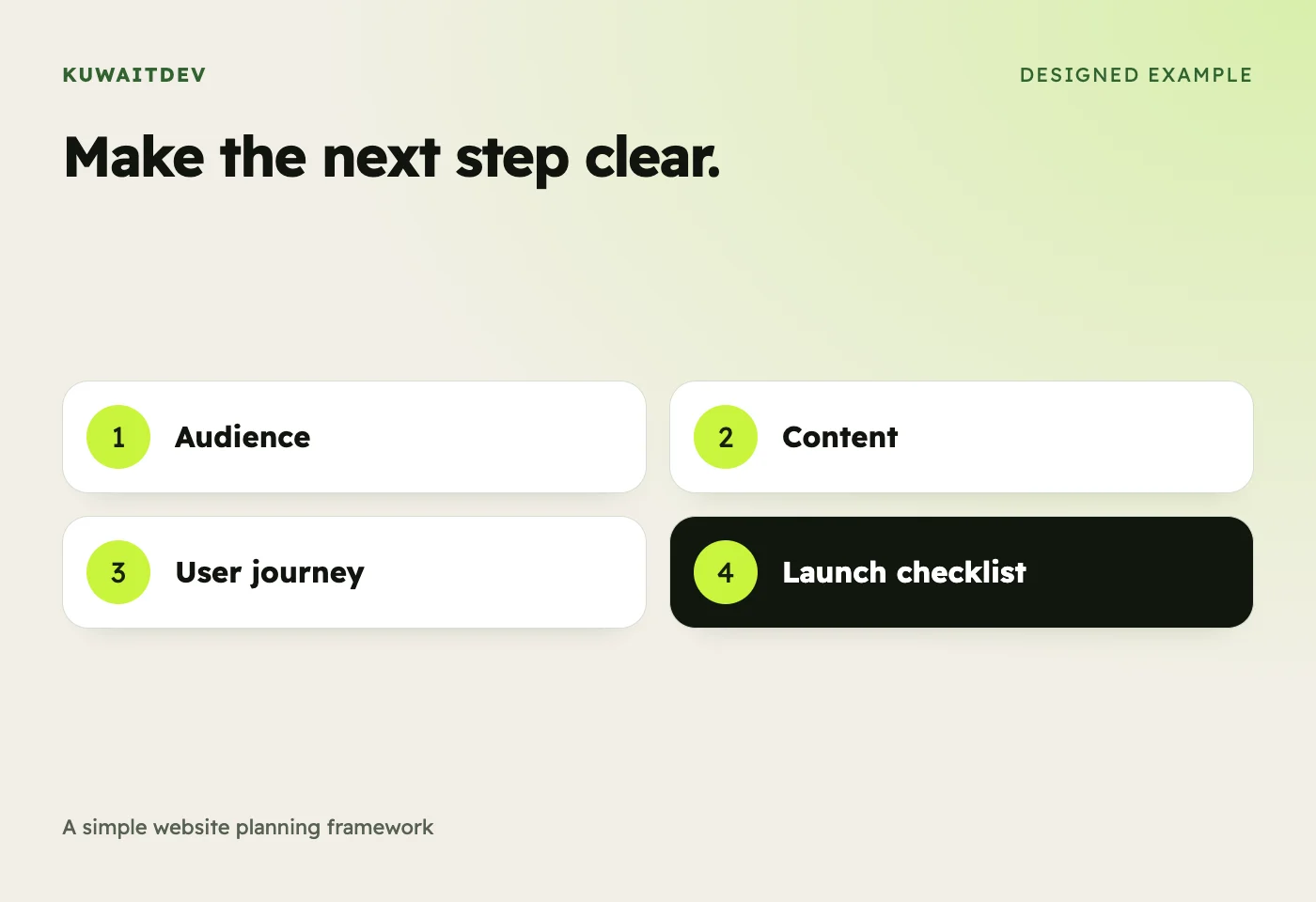
Before you talk to any web development company, settle six things: what the website is supposed to achieve, who it is for, what pages it needs, what content and photos you have, which languages and payment methods it must support, and who updates it after launch. That takes an afternoon. It is the difference between a quote you can trust and a quote that changes three times during the project. This guide walks through each decision, and ends with a one page checklist you can fill in and bring to your first meeting.
Start with the goal, not the pages
Almost every Kuwait business that contacts a developer starts by describing the site. Start with the job instead. A website is bought to produce one of a small number of results, and the right build looks different for each.
| Your goal | What that means for the build | What you measure |
|---|---|---|
| Get enquiries and phone calls | Clear service pages, phone and WhatsApp on every screen, a short form | Calls, WhatsApp messages, form submissions |
| Sell products online | Catalogue, cart, KNET and card checkout, delivery areas, stock | Orders, average order value, abandoned carts |
| Take bookings | Calendar, reminders, staff or branch selection | Bookings made, no-show rate |
| Look credible to buyers who already know you | Portfolio, clients, certifications, fast loading, good Arabic | Time on page, enquiries from existing contacts |
| Replace paperwork inside the company | Logins, roles, forms, reports | Hours saved per week |
Write one sentence: “This website exists so that ______.” If two people in your company write different sentences, resolve that before you speak to anyone. Disagreement about the goal is the most expensive problem in a website project, and it always surfaces later as “can we just change the homepage”.
Be honest about who the site is for as well. A site aimed at Kuwaiti retail customers, a site aimed at government procurement officers and a site aimed at international partners are three different sites, even for the same company.
Decide your pages and what each one has to do
Make a list. Not a wireframe, not a design, just a list with one line per page saying what a visitor should do there. A normal Kuwait business website is somewhere between five and fifteen pages:
- Home
- About the company
- One page per service or product category, which is where search traffic actually lands
- Prices, if you publish them
- Portfolio, clients or case studies
- Contact, with a map, WhatsApp, phone and working hours
- Blog or news, only if someone will actually write it
Two rules save money here. First, one page per thing people search for. A single “Services” page listing eight services will not be found by anyone searching for one of them. Second, do not plan a blog unless a named person has agreed to write it. An abandoned news section with its last post from 2024 does more damage than no news section.
Content and photos: what actually delays the project
This is the honest part that most agencies skip in the sales meeting. Development rarely holds a project up. Content does. Plan for it:
- Text. Who writes it, you or the agency. If the agency writes it, they need an hour of interview per major page and they need a subject expert to answer questions.
- Photos. Real photos of your premises, staff, products and work beat stock images every time, and Kuwaiti customers can tell the difference immediately. Budget for a photographer if you do not have them.
- Logo and brand files. The actual vector file, not a screenshot from Instagram. Brand colours and fonts if they exist.
- Proof. Licence number, certifications, client names you are allowed to publish, and any awards you can evidence.
- Legal text. Terms, returns and privacy. If you take payments you need these before launch, not after.
- Both languages. Decide now whether you are writing Arabic first or English first, and who is responsible for the second. The bilingual website guide covers why this decision cannot be postponed.
Languages, payments and integrations
Three questions that change the hour count more than anything else on the design side.
Languages. Arabic and English is the normal answer in Kuwait, and it should be a true right-to-left layout rather than a mirrored English one. Build both together and it adds 20% to 35% to the hours. Add the second language later and it costs 30% to 50% of the original build.
Payments. If you take money online you need KNET, because it is the national debit network and the most used way to pay in Kuwait. That usually means MyFatoorah or Tap Payments, which also give you Visa, Mastercard and Apple Pay in the same signup. Approximate public fees are about 0.250 KWD per KNET transaction through a gateway, or about 0.100 KWD with KNET direct, plus around 2.5% on cards. KNET direct is cheaper per transaction but slower to set up because it goes through your bank.
Everything else it has to talk to. Your accounting or ERP system, a CRM, WhatsApp, a delivery company, a booking calendar, an existing customer database. List them now. Each integration adds hours, and each one has to be discovered before the quote rather than after.
Budget, timeline and who owns it afterwards
At 10 KWD per hour, the arithmetic is simple: cost equals hours times 10. The smallest projects start around 200 KWD. A landing page is normally 20 to 33 hours, a business website 33 to 85 hours, and a web application with accounts and dashboards 135 to 335 hours or more. The website cost guide breaks this down by project type, and the cost calculator gives you a range in a couple of minutes.
Come to the meeting with a range you are comfortable with, not a number you are hiding. An engineer who knows your ceiling can tell you what fits inside it and what has to wait for phase two. An engineer guessing at your budget will either over-scope or under-build.
On timeline, work backwards from a real date if you have one (a launch, an exhibition, Ramadan trading) and add slack for content. Remember the Kuwait working week runs Sunday to Thursday, which matters if your other suppliers are abroad.
Then decide the question nobody asks until it is too late: who owns the site after launch. Who can log in, who changes a price, who renews the domain, who is called at nine at night when checkout stops working. Agree that before you sign, along with who owns the code and the accounts. The agency versus freelancer comparison goes through what each type of supplier gives you after launch.
Your one page planning checklist
Print this, fill it in, bring it.
- One sentence: this website exists so that ______
- Who it is for, in plain words
- Page list, one line per page saying what the visitor should do there
- Languages, and which one is written first
- Who writes the text, and by when
- Photos: what exists, what needs shooting
- Logo in vector format, brand colours and fonts
- Payments: do you take money online, and which methods
- Systems it must connect to (accounting, CRM, WhatsApp, delivery, booking)
- Two or three websites you like, with one line each on why
- One website you dislike, and why
- Budget range you are comfortable with
- Date it needs to be live, and what happens if it is not
- Who updates the site after launch
- Who owns the domain, the hosting and the code
What to do next
If you can answer most of that list, you are ready to get real quotes. If you cannot, that is normal, and it is exactly what the free one hour consultation is for. It is with an engineer rather than a salesperson, and the output is an hour estimate and an honest opinion about what you should not build yet. Start from the technical consultation page, or read what a full build includes on our web development page.