

The challenge
The common trap is spending six months and a few thousand dinars building every feature before finding out whether anyone will pay. The alternative is not building something cheap and throwaway. It is picking the one thing your product has to do, building that properly, putting it in front of real users in Kuwait, and letting what they do decide what gets built next.
Launch fast, iterate faster. An MVP is the smallest version of your idea that a real customer in Kuwait can use and pay for, built in four to eight weeks instead of six months, so you learn from behaviour rather than from opinions collected in a majlis. The point is not to build something cheap. It is to find out whether the expensive version is worth building.
How a startup proves itself in Kuwait
The market here is small and connected, which cuts both ways. Word of mouth moves fast, so a product that works spreads without much advertising, and one that frustrates people gets talked about just as quickly. Most early traction comes from Instagram, WhatsApp and personal networks rather than search, so the first version needs to survive a stranger arriving from a story link on a phone with no explanation attached.
Two Kuwait-specific things decide a launch date more often than code. Payment gateways need a commercial registration and a company bank account before they will approve you, so start the paperwork the same week you start the build. And Arabic is not a phase two item. If your customers speak Arabic and your product does not, you are testing the wrong product.
What goes in the first version, and what does not
In: the one thing that makes the idea work. If you are building a booking product, that is booking. If it is a marketplace, it is the first successful transaction between two strangers. Everything on the screen should serve that.
In: payments, if you intend to charge. Free users tell you almost nothing. A KNET checkout in the first version turns a compliment into evidence.
In: analytics that answer one question. Did people come back. Visitor counts are comfortable and useless.
Out: an admin panel for a business you do not have yet. For the first few weeks you can run operations by hand and learn more from doing it.
Out: five user roles, a loyalty scheme and a referral programme. These are answers to questions nobody has asked you yet.
Out: a rebuild-proof architecture for a million users. We build so it can grow, which is a different thing from building for scale you have not earned. Our technical consultation exists partly to have this argument with you before anyone writes code.
What a typical project looks like
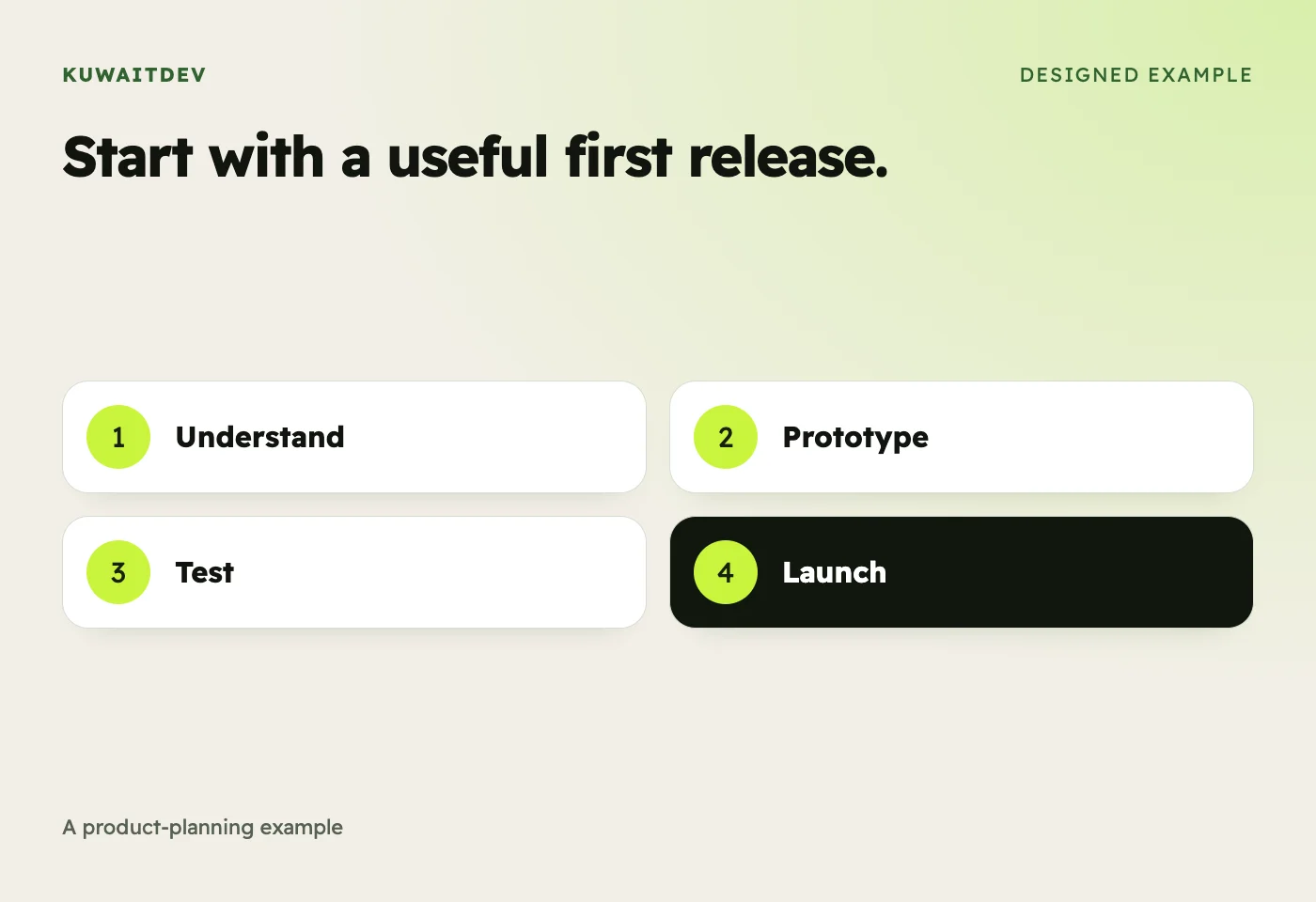
- Free first hour with an engineer. We try to shrink the idea, not flatter it. You leave with a scope, a number of hours and a date.
- Scope and screens. One week of deciding what is in, what waits, and what the main flow looks like. Interface design in Arabic and English happens here, and our website planning guide covers the same groundwork.
- Build in two-week cycles. Something usable at the end of each one, on a link you can show people.
- Payments and accounts. Gateway set up in your company’s name, tested with real transactions including refunds.
- Launch to a small group first. Twenty real users will show you more than another month of building.
- Decide with data. Every two weeks after launch, what to fix, what to drop, and whether to invest in a mobile app.
What it costs
At 10 KWD per hour, a first version runs 17 to 85 hours.
| First version | Hours | Cost |
|---|---|---|
| Landing page with waiting list or booking form | 17 to 30 | 170 to 300 KWD |
| Web product with accounts, dashboard, payments | 30 to 60 | 300 to 600 KWD |
| Larger first version, mobile app or marketplace | 60 to 85 | 600 to 850 KWD |
Price your own scope in the cost calculator, and see how the hourly rate and partnership discounts work on the pricing page. Founders who already have traction and need a full platform can move straight to our web development practice, at the same rate and with the same team.