

The challenge
People in Kuwait now compare a ministry or authority website with the apps they use every day, and they arrive on a phone, in Arabic, wanting one specific thing done. Most public sector sites are built as publishing platforms instead, so the service is buried under announcements and the transaction ends at a downloaded form and a visit to a counter.
Someone arriving on a ministry, authority or public body website in Kuwait almost always wants one specific thing: what are the requirements, which documents do I need, how much is the fee, and can I do it without coming in person. The site succeeds or fails on how fast it answers those four questions in Arabic on a phone. Everything else, including the news section, is secondary. Projects on this page run 85 to 235 hours at 10 KWD per hour, so 850 to 2,350 KWD.
What the public now expects
Kuwaiti residents already complete government transactions on their phones through the national services app, and they compare every other public sector site with that experience. A citizen who can renew something in two minutes in one place will not accept a downloaded PDF, a printed form and a trip to a counter somewhere else.
That comparison sets the bar for a public body website. It has to be readable on a five year old phone, it has to work in Arabic first, and it has to end in a completed transaction or at least a clear answer. A site organised around departments and internal structure fails this test, because the citizen does not know or care which department owns the service.
The features that matter, and why
A service catalogue, not a site map. Every service gets its own page, named the way people ask for it, with eligibility, required documents, the fee, how long it takes, and the action button. This single change does more for a public sector site than any redesign, because it converts browsing into finishing.
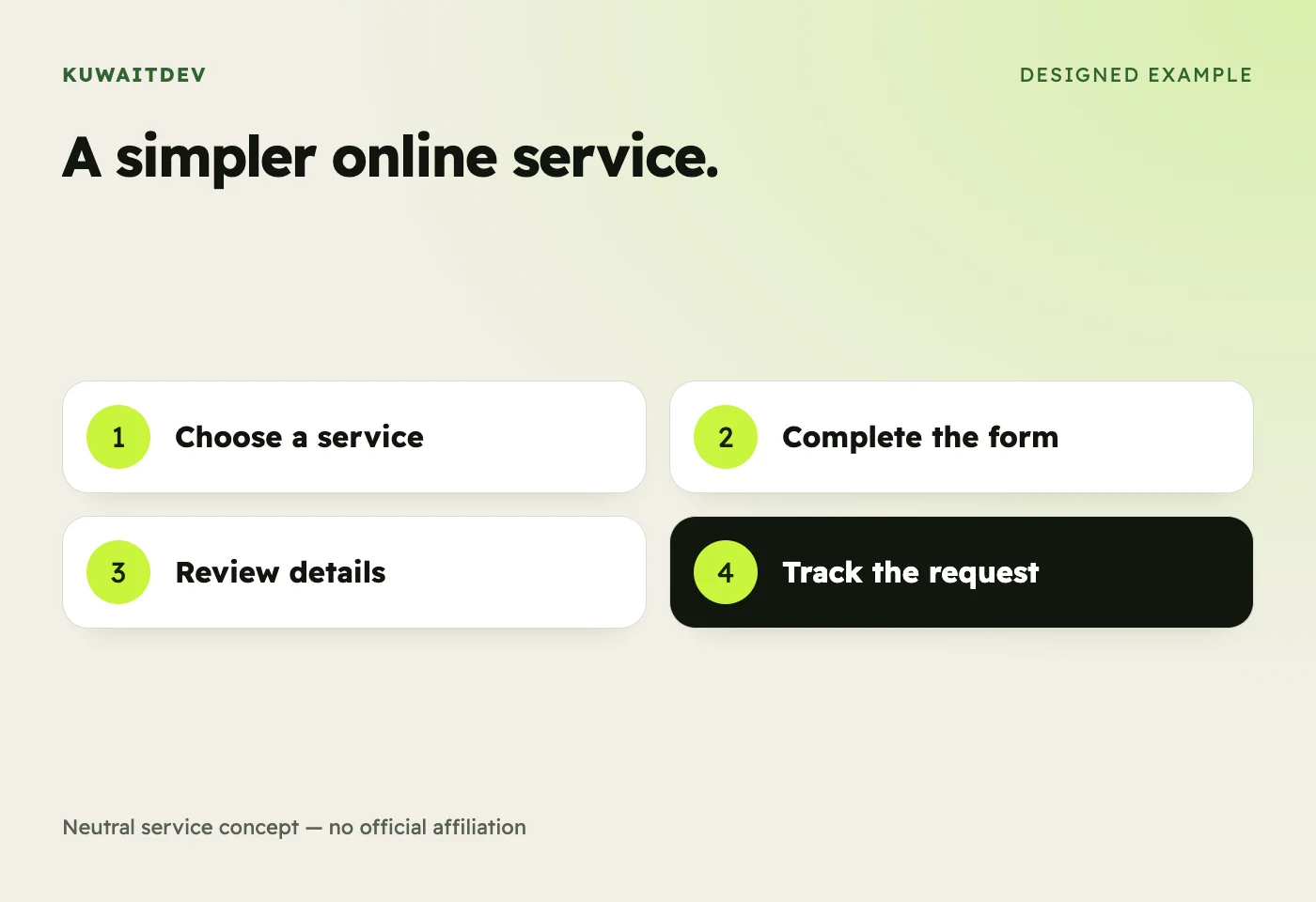
Forms that submit. A downloadable PDF is a form that has not been built. Online submission with civil ID, document upload, validation at the point of entry and a reference number afterwards removes the counter visit for the applicant and removes the retyping for your staff. This is where our custom software work usually sits inside a government project.
Status you can check. Once an application has a reference number, the applicant should be able to see where it is without telephoning. Most of the call volume on a public service line is a status question, and most of that disappears when the status is visible.
Payment. Fees paid with KNET with an immediate receipt, plus a daily reconciliation file for finance. Reconciliation is the part that gets forgotten in the specification and causes problems in month one.
Arabic and English as equals. Not a translated afterthought. The Arabic version is written for citizens and laid out right to left, including forms, tables, dates and error messages. We set out how this is done in the bilingual website guide and build it as a proper bilingual site rather than a language plugin.
Accessibility. Contrast, headings, labelled fields, keyboard navigation and screen reader support. A public body is serving everybody, including people with visual impairments and older users, and these are cheap during a build and expensive afterwards.
Security and audit. Staff accounts with permissions by role, a log of who saw and changed what, and hosting arrangements that satisfy your IT department. Where data has to stay in the country, the servers sit in Kuwait.
What a typical project looks like
- A free first hour with an engineer, then a short discovery to list every service the body delivers and how many people actually use each one.
- Ranking services by demand, so the top handful are built properly rather than all of them being built badly.
- Arabic screens designed first, English second, reviewed by the people who answer the phones today.
- The service catalogue and content structure are built, then the forms, then payment and status tracking.
- Accessibility testing, load testing for deadline days, and a security review before launch.
- Staff training, a phased launch, and support through the first busy period.
Deadline days deserve special mention. Public services have peaks, when a renewal window closes or a registration period opens, and a site that copes on a normal Tuesday can still fall over on those days. We plan capacity around the peak, not the average.
What it costs
| Scope | Hours | Cost |
|---|---|---|
| Bilingual informational site with a proper service catalogue and enquiry forms | 85 to 120 | 850 to 1,200 KWD |
| The same plus online applications, document upload, KNET fees and status tracking | 135 to 185 | 1,350 to 1,850 KWD |
| Full portal with citizen accounts, internal staff workflow, reporting and integrations | 200 to 235 | 2,000 to 2,350 KWD |
The rate is 10 KWD per hour with published discounts for longer engagements on the pricing page, and the wider approach to building fast bilingual sites is on our web development page. Hosting, certificates and maintenance are quoted separately and in writing, because an unbudgeted renewal is the most common reason a good public sector site degrades in its second year.