

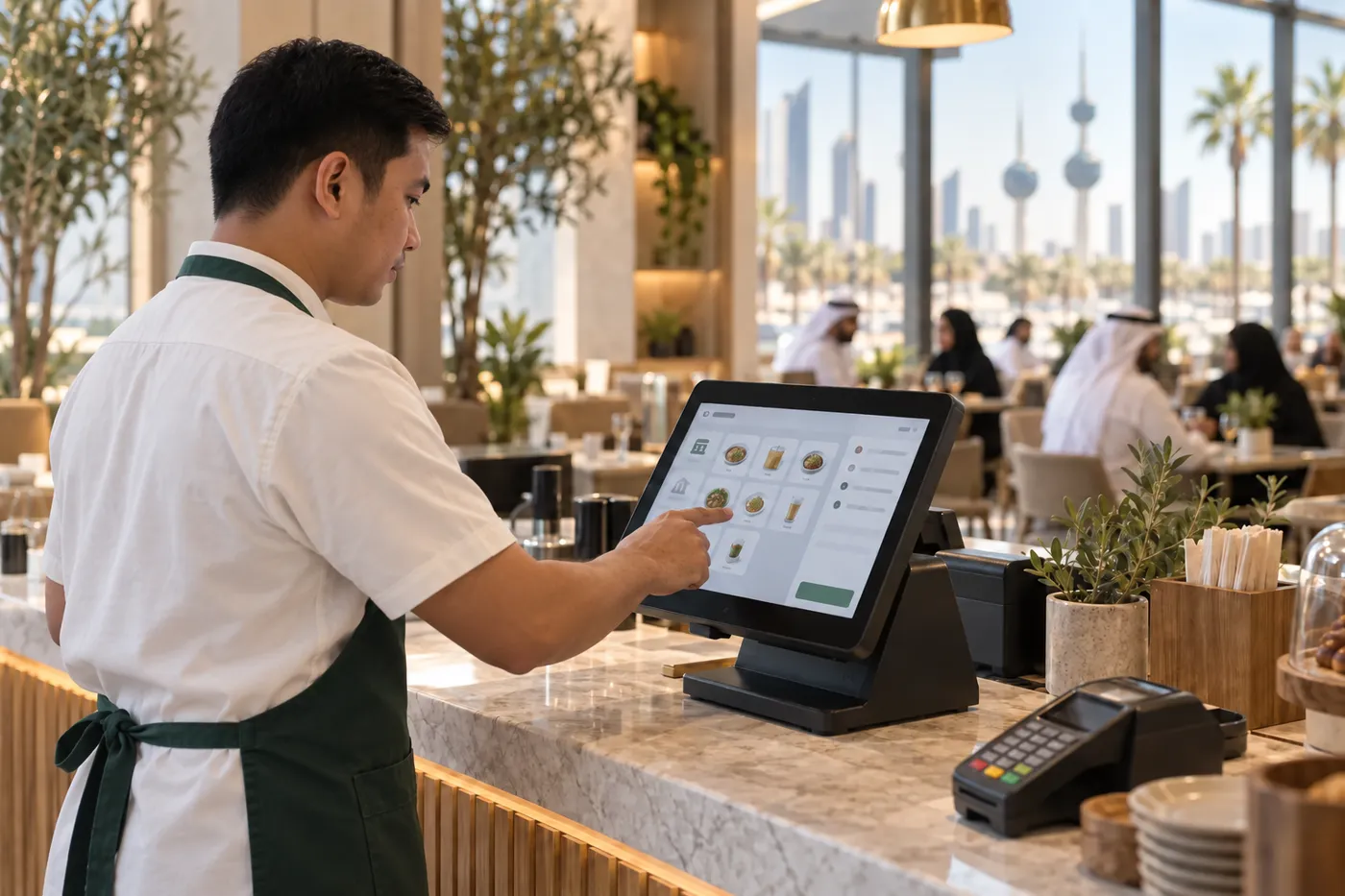
We build point of sale systems for Kuwait shops, restaurants and salons: Arabic and English at the counter, KNET and cash on the same receipt, stock that updates as you sell, and a till that keeps working when the internet drops. A system takes 35 to 135 hours at 10 KWD per hour, which is 350 to 1,350 KWD.
The problem with the POS you have now
Most Kuwait businesses are running one of three things. A cash drawer and a notebook, which works until you open a second branch. An imported POS built for a different market, where the Arabic is broken, the receipt prints upside down and there is no sensible way to handle a discount your manager gives in person. Or a subscription system that charges per terminal per month and still cannot handle your delivery orders, your packages or your branch pricing.
The cost of this is not the subscription. It is the thirty minutes every evening spent reconciling the drawer, the stock figure nobody trusts, the online store that sells an item the shop floor sold an hour earlier, and the fact that you cannot tell which branch made money last week without asking someone to build a spreadsheet.
A POS is worth building when the rules of your business are specific enough that the ready-made options force your staff into workarounds. If they do not, a subscription product is the cheaper answer and we will tell you that in the first hour.
What you get
- A till screen your staff can learn in an afternoon, in Arabic or English, with receipts printed in both.
- Payments split across KNET, cash and card on one sale, recorded so the drawer balances at shift close.
- Offline trading. The terminal keeps selling without a connection and syncs when it returns.
- Stock that moves as you sell, per branch and in total, with transfers between branches and low stock alerts.
- Staff accounts and permissions, so a discount, a void or a refund is tied to the person who made it.
- Shift close and cash reconciliation, with the difference visible instead of argued about.
- Live reporting you can open on your phone: sales by branch, by hour, by product, by staff member.
- One stock pool shared with your online store, so the counter and the website never disagree.
How we work
- Free first hour with an engineer. We go through how you actually sell, including the exceptions your staff handle by hand today.
- Written scope. Screens, payment rules, stock rules, branches, roles and reports, priced in hours before anything is built.
- The counter screen first. We build and test the part your staff touch all day, with the real products and real prices of one branch.
- Stock, branches and reporting. Transfers, purchase entry, suppliers, permissions and the reports you will look at every morning.
- One branch live. A week of real trading on one till, with us watching and fixing. Staff find things no specification does.
- Rollout and handover. Remaining branches and terminals, staff training in Arabic, and a support arrangement for the first months.
Cost and timeline
| Scope | Hours | Cost at 10 KWD/hour | Typical time |
|---|---|---|---|
| One branch, one till, basic stock | 35 to 55 | 350 to 550 KWD | 4 weeks |
| One branch with packages, delivery or bookings | 55 to 85 | 550 to 850 KWD | 5 to 6 weeks |
| Several branches, central stock, full reporting | 85 to 135 | 850 to 1,350 KWD | 7 to 8 weeks |
Hardware is separate and you buy it yourself: terminals, printers, scanners and the KNET card machine from your bank. You can model a wider project in the cost calculator.
How it fits with the rest of your business
A POS is one part of selling. If the same products are sold online, build both against one stock pool through our ecommerce development practice or a Shopify store connected to the counter. If purchasing, accounting and payroll are also being run on spreadsheets, an Odoo implementation with the POS on top is usually the better shape. For online payments, our payment gateway practice covers KNET and the rest of the checkout.
Pitfalls to avoid
- Designing for the owner, not the cashier. The screen is used a hundred times a day under pressure. Fewer taps beats more features.
- Assuming the internet. Kuwait connections drop. If the till stops when the line does, the system is not finished.
- Rolling out to every branch at once. One branch for a week first, always.
- Bolting on stock later. Stock rules decided after launch mean re-counting everything by hand.
- Skipping permissions. Voids and discounts without a name attached are how shrinkage starts.
- Ignoring the receipt. A Kuwait receipt needs correct Arabic, three decimal places on the dinar and your commercial registration details.
Book a free consultation and bring one week of your sales. We will tell you whether to build or subscribe.