

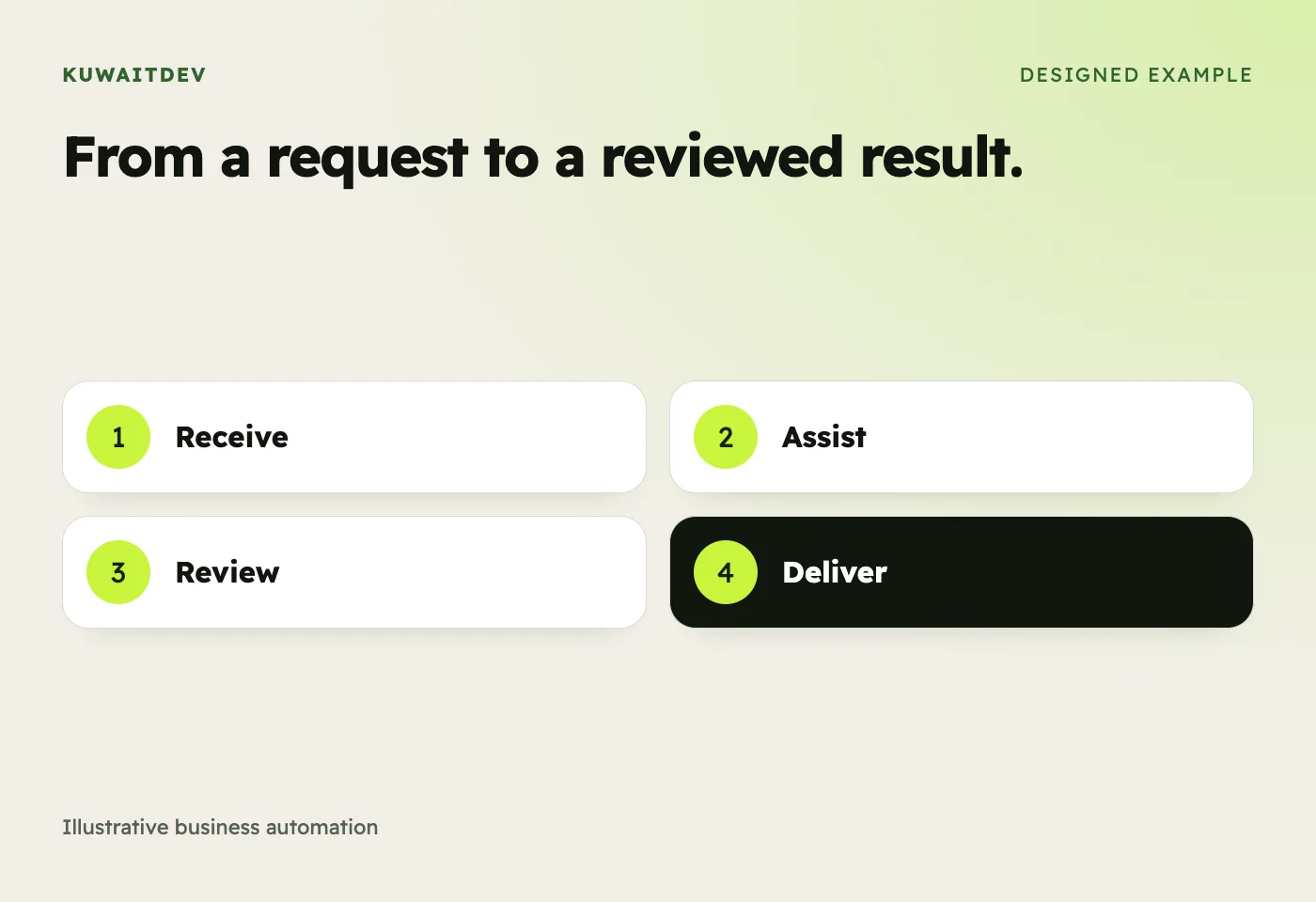
For most small and mid-size businesses in Kuwait, AI is not a strategy. It is a way to stop losing the customer who messages at eleven at night and gets no reply until the next morning. The applications that are actually paying for themselves are narrow and unglamorous: answering repeat questions on WhatsApp, taking a booking, chasing an order, sorting incoming enquiries so the right person sees them first, and reading long documents so a person does not have to. This guide covers what each one does, roughly what it costs in hours, what it cannot do, and where a human has to stay in the loop.
What Kuwait businesses are actually using AI for
AI is not only for tech companies. Businesses across Kuwait are using it to answer customers faster and cut repeat admin work. The pattern is the same in most industries: the machine handles the question that has one correct answer, and a person handles everything else.
| Industry | What AI handles well | What your staff still handle |
|---|---|---|
| Restaurants | Taking an order over chat, menu questions, delivery areas, opening hours | Complaints, large catering orders, anything involving a refund |
| Clinics | Appointment scheduling, reminders, directions, what to bring, insurance basics | Anything clinical, triage, changing a doctor’s schedule |
| Ecommerce | Product recommendations, order status, size and stock questions, returns policy | Damaged goods, wrong item, payment disputes |
| Real estate | Matching a buyer or tenant to listings by area, budget and size | Viewings, negotiation, contracts |
| Services and contracting | Qualifying an enquiry, collecting the details before a quote | Pricing the job, site visits |
The right column is where the money and the risk sit. AI is worth buying when it clears the left column so your people spend their day on the right one.
Answering customers on WhatsApp without hiring a night shift
WhatsApp is where Kuwaiti customers talk to businesses. Most shops find that a large share of their messages are the same handful of questions: are you open on Friday, where exactly are you, how much, do you deliver to Jahra, do you take KNET. Those do not need a human. They need a correct answer in under a minute, in the language the customer wrote in.
A WhatsApp assistant is connected to your official WhatsApp Business number, given your real information (hours, branches, prices, delivery areas, policies), and told to hand the conversation to a person the moment the question falls outside what it knows. Our WhatsApp Business integration service is normally 10 to 27 hours. The assistant layer on top sits in the same range as a standard AI chatbot build.
The part people underestimate is the content. Someone has to write the answers down. If nobody has ever written your delivery areas or return policy in one place, that is the first week of the project, not the coding.
Bookings, order follow-up and the quiet admin jobs
Once the assistant is answering, the next step is letting it act rather than only reply. Three jobs are worth the effort for most Kuwait businesses:
- Bookings. The customer picks a slot in the chat, the slot is written into the same calendar your staff use, and a reminder goes out the day before. This cuts no-shows because the reminder arrives on the channel people actually read.
- Order follow-up. After delivery, a short message asks whether everything arrived correctly. Problems surface while you can still fix them, instead of appearing as a review two weeks later.
- Sorting enquiries. Every message that comes in gets a one-line summary and a label (new order, complaint, price request, supplier, spam) before a person opens it. On a busy day this is the difference between answering the buyer first and answering whoever messaged first.
These are automation projects rather than chat projects. They fall inside the range on our AI automation service, and they only work if they are wired into the system you already use, whether that is a booking sheet, an online store or an ERP.
Arabic support that does not read like a translation
This is where most cheap AI projects in Kuwait fail. Customers do not write formal Arabic. They write Kuwaiti dialect, switch to English mid-sentence, and many write Arabic in Latin letters. An assistant tuned on standard Arabic will understand a question about “التوصيل” and miss the same question written as “twseel”. What makes the difference in practice:
- Test with your own message history, not with sample questions. Take two hundred real chats and check the replies.
- Decide the tone once. A clinic and a perfume shop should not sound the same.
- Reply in the language the customer used. If they wrote Arabizi, reply in Arabic or English, whichever your brand uses, but never in Arabizi.
- Keep prices, model names and brand names in the form your customers search for.
The same thinking applies to your website. The bilingual website guide covers how Arabic and English content should be handled so the assistant has something accurate to read from.
What it costs in hours
Everything below is at 10 KWD per hour, and the hours are the range we normally see. Your own estimate comes out of the free consultation, not out of this table.
| What you are building | Typical hours | Cost at 10 KWD/hour |
|---|---|---|
| WhatsApp Business number connected properly | 10 to 27 | 100 to 270 KWD |
| Assistant that answers your repeat questions | 17 to 55 | 170 to 550 KWD |
| Adding bookings or order follow-up to it | 17 to 180 | 170 to 1,800 KWD |
| Custom build: document processing, recommendations | 65 to 180 | 650 to 1,800 KWD |
| Full system with several connected workflows | 265 to 535+ | 2,650 KWD and up |
Two running costs are not in that table and you should ask about both before you sign. The AI provider charges per message processed, and WhatsApp charges per conversation. Both are small per message and both scale with volume, so a shop with two hundred chats a month and one with twenty thousand are in different worlds. The AI solutions cost article breaks the build side down further.
What AI cannot do
Be clear about this before you spend anything.
- It cannot know what you never wrote down. If your prices live in the head of one employee, the assistant will not have them.
- It cannot be trusted with live numbers unless it is connected to the live system. Stock and prices must be read from your store or ERP, not typed in once and forgotten.
- It will be confidently wrong. Given a question outside its material, an unconstrained assistant invents an answer. Constraining it to say “let me pass you to a colleague” is a deliberate setup choice.
- It cannot handle an angry customer. A complaint answered by a machine usually gets worse.
- It cannot make commitments for you. Discounts, refunds, medical advice, legal positions and delivery promises belong to a person.
Where a person has to stay in the loop
Set these rules on day one, in writing:
- Any message containing a complaint, a refund request or a legal or medical question goes straight to a human, no reply attempted.
- A named person reviews the previous day’s conversations for the first month. This is how you find the wrong answers.
- Nothing that changes money (a price, a discount, a refund) is issued without a person approving it.
- The assistant identifies itself as an assistant if asked. Pretending to be staff costs you trust the first time a customer notices.
- One person owns the content. When a price, a branch or a policy changes, they update the assistant the same day.
How to start
Pick the single question your staff answer most often and count how many times a week they answer it. If the number is embarrassing, that is your first project, usually a two to three week build. Write your answers down before the project starts, because that content is the real deliverable.
When you are ready, book the free one hour consultation on our AI solutions page. It is with an engineer who will tell you whether the thing you want is worth building, including when the answer is that a better form on your website would solve it for a tenth of the cost.